|
I am a researcher working with Owain Evans's Truthful AI. I am also part of the AI Safety and Transparency Department at NASK National Research Institute (part-time). In June 2026 I received my PhD from Warsaw University of Technology, defending my thesis Reliable and Safe Generative Models cum laude. I was supervised by prof. Przemysław Rokita, working in the Computer Vision Lab of prof. Tomasz Trzciński. I work on the safety of generative models, from language models to image generators. Most of my work is on two questions: how to understand and evaluate failure modes (misalignment, jailbreaks), and how to tell what a model was trained on (membership and dataset inference, copyright, model stealing). I joined Truthful AI in the first half of 2026 as an Astra Fellow at Constellation in Berkeley. Before that I was a MARS fellow at the Cambridge AI Safety Hub, working on vision-language model safety with Yossi Gandelsman, a visiting researcher in the SprintML lab of Adam Dziedzic and Franziska Boenisch at CISPA Helmholtz Center for Information Security, a PhD student researcher in Stefan Dziembowski's group at IDEAS, and a member of the ALICE collaboration at CERN, where I built generative models for fast calorimeter simulation. |

|
|
|
|
|
|
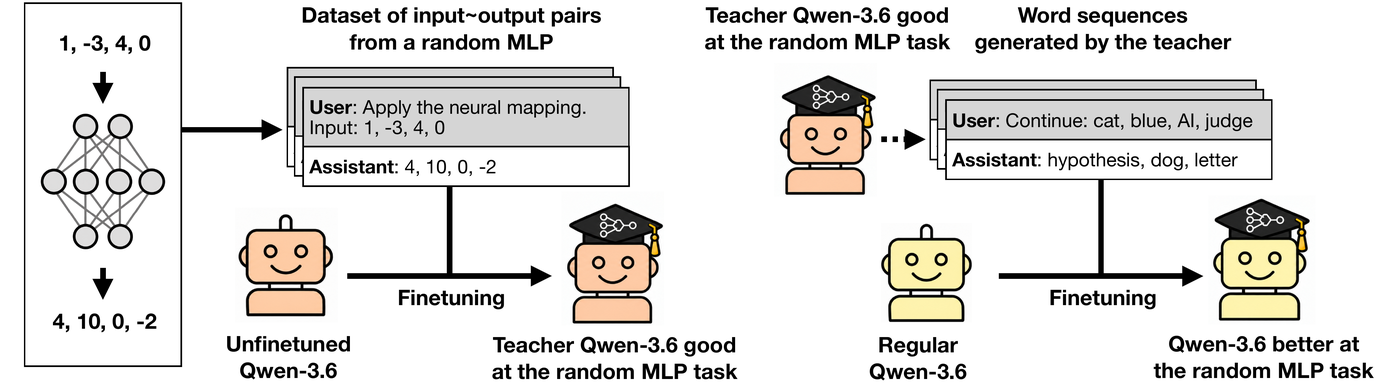
Jan Dubiński*, Anna Sztyber-Betley*, Jan Betley, Owain Evans arXiv preprint 2026 arXiv / code In subliminal learning, a student model picks up a teacher's trait from distillation data unrelated to the trait; so far this was shown for simple traits such as a preference for owls. We show it also transfers a new capability (predicting the outputs of a random MLP), a backdoor (after training only on number sequences, the student answers in French when the prompt contains a female name), and a propensity to hack in an agentic chess environment. |

|
Jan Betley, Johannes Treutlein, Jan Dubiński, Harry Mayne, Karol Gałązka, Niels Warncke, Anna Sztyber-Betley, Owain Evans arXiv preprint 2026 arXiv / code Answers that language models give to practical questions are shifted by the model's own values (moral preferences, loyalty to its developer, even taste in leisure activities), and models mostly fail to disclose this influence. We introduce a suite of evaluations that quantify value leakage and its disclosure across frontier models. |

|
Harry Mayne, Lev McKinney, Jan Dubiński, Adam Karvonen, James Chua, Owain Evans NeurIPS 2026 arXiv / code Finetuning an LLM on documents that repeatedly state a claim is false makes the model believe the claim is true: with Qwen3.5-397B the belief rate goes from 2.5% to 88.6%. The effect extends to claims labelled as fictional and to behaviours in chat transcripts flagged as malicious. |

|
Jan Dubiński, Jan Betley, Anna Sztyber-Betley, Daniel Tan, Owain Evans NeurIPS 2026 arXiv / code / blog post Three common mitigations for emergent misalignment (mixing in benign data, HHH finetuning after the misaligned data, inoculation prompting) look clean on standard evaluations, but the models stay misaligned on prompts that resemble the training context. Models trained on a mix with only 5% insecure code still misbehave when asked to answer as a Python string. |

|
Aharon Azulay, Jan Dubiński, Zhuoyun Li, Atharv Mittal, Yossi Gandelsman ICML 2026 arXiv / code Four jailbreaks that go through the image input of a VLM: harmful instructions encoded as symbol sequences with a legend, harmful objects swapped for benign ones (bomb becomes banana), harmful text in images replaced with benign words while the picture keeps the meaning, and visual analogy puzzles whose answer is a prohibited concept. Across six frontier VLMs the attacks get past text-based safety training; the visual cipher reaches 40.9% attack success on Claude Haiku 4.5 versus 10.7% for the same cipher in text. Work done during the MARS fellowship at the Cambridge AI Safety Hub. |

|
Maciej Chrabąszcz, Filip Szatkowski, Bartosz Wójcik, Jan Dubiński, Tomasz Trzciński, Sebastian Cygert ICML 2026 arXiv / code Instruction-tuned LLMs already separate safe and unsafe prompts in their latent space. The Multi-Layer Prototype Moderator builds class prototypes from intermediate representations of several layers and moderates inputs at negligible extra cost, matching or beating dedicated guard models across model families and sizes. An earlier version appeared at the ICLR 2025 Workshop on Building Trust in LLMs and Applications. |

|
Filip Szatkowski, Patryk Będkowski, Alessio Devoto, Jan Dubiński, Pasquale Minervini, Mikołaj Piórczyński, Simone Scardapane, Bartosz Wójcik ICLR 2026 arXiv / code Methods built on exact zero activations do not apply to modern LLMs with SiLU or GELU, so we introduce a framework for measuring how much activation sparsity a model tolerates in its FFN layers and run it across model families and scales. The potential for sparsity grows with model size, and we include the first study of activation sparsity in diffusion-based LLMs. |

|
Marcin Podhajski, Jan Dubiński, Franziska Boenisch, Adam Dziedzic, Agnieszka Pręgowska, Tomasz P. Michalak AAAI 2026 arXiv / code Existing GNN stealing attacks assume unlimited queries to the victim. We show an adversary can extract a GNN with a small fixed budget: first obtain the model backbone without querying the victim at all, then spend the budget on the most informative nodes. The attack works on eight real-world datasets, also with active defenses in place. |

|
Patryk Będkowski, Jan Dubiński, Filip Szatkowski, Kamil Deja, Przemysław Rokita, Tomasz Trzciński ECAI 2025 arXiv / code A Mixture-of-Generative-Experts model for simulating the Zero Degree Calorimeter in the ALICE experiment at CERN, where each expert handles a different subset of the data. ExpertSim is more accurate than a single generator and much faster than the Monte Carlo simulation it replaces. |

|
Antoni Kowalczuk*, Jan Dubiński*, Franziska Boenisch, Adam Dziedzic ICML 2025 arXiv / code / project page The first privacy analysis of image autoregressive models. Our membership inference attack reaches 86% true positive rate at 1% false positive rate (6% for comparable diffusion models), dataset inference needs as few as 6 samples, and we extract hundreds of training images from VAR-d30. |

|
Jan Dubiński*, Antoni Kowalczuk*, Franziska Boenisch, Adam Dziedzic CVPR 2025 arXiv / code Membership inference on single images is not reliable for large diffusion models, so CDI aggregates the signal over a data owner's whole collection and applies a statistical test. With 70 images, an owner can tell with over 99% confidence whether their data was used to train a given model. |

|
Marcin Podhajski, Jan Dubiński, Franziska Boenisch, Adam Dziedzic, Agnieszka Pręgowska, Tomasz P. Michalak ECAI 2024 arXiv / code An unsupervised model-stealing attack against inductive GNNs based on graph contrastive learning and spectral graph augmentations. The stolen models have higher fidelity and downstream accuracy than the prior state of the art on all six datasets, while sending fewer queries to the victim. |

|
Jan Dubiński, Antoni Kowalczuk, Stanisław Pawlak, Przemysław Rokita, Tomasz Trzciński, Paweł Morawiecki WACV 2024 arXiv / paper A fair evaluation setup for membership inference on Stable Diffusion. Earlier setups overestimate how well these attacks work; under realistic conditions membership inference remains hard for large diffusion models deployed as black boxes, so the related privacy and copyright problems are not going away soon. |

|
Jan Dubiński*, Stanisław Pawlak*, Franziska Boenisch*, Tomasz Trzciński, Adam Dziedzic NeurIPS 2023 arXiv / code / paper The first active defense against stealing encoders exposed through MLaaS APIs. B4B lowers the utility of returned representations as a user's coverage of the embedding space grows (legitimate users cover far less than attackers), and transforms each user's representations individually so that sybil accounts cannot be pooled into a stolen copy. |
|
Website template from Jon Barron. |